Design Sprints
Design Sprints
Design Sprints

You don't need six months to know if an idea is worth pursuing. You need five days and the right process.
What are Design Sprints?
Detroit Labs is trained in the Google Ventures Design Sprint methodology. A sprint is a five-day process for answering critical business questions through design, prototyping, and testing with real users. It compresses months of debate, assumption, and guesswork into one focused week and ends with a clickable prototype and real customer reactions in your hands.
What are Design Sprints?
Detroit Labs is trained in the Google Ventures Design Sprint methodology. A sprint is a five-day process for answering critical business questions through design, prototyping, and testing with real users. It compresses months of debate, assumption, and guesswork into one focused week and ends with a clickable prototype and real customer reactions in your hands.
Benefits
A clickable prototype in your hands by Friday
Direction backed by real user feedback, not internal opinion
Stakeholder alignment before any significant investment
A prototype ready to take back to your organization
Assumptions tested before they become expensive
One week instead of months
Benefits
A clickable prototype in your hands by Friday
Direction backed by real user feedback, not internal opinion
Stakeholder alignment before any significant investment
A prototype ready to take back to your organization
Assumptions tested before they become expensive
One week instead of months
What you walk away with
At the end of a Design Sprint, you have two things most teams spend months trying to get.
The first is a clickable prototype. Not a static deck. Not a set of wireframes. A realistic, interactive simulation of your product that looks and behaves like the real thing. It is built in a single day and designed specifically to be put in front of users, but it is also polished enough to present to a leadership team, a board, or an investor. You can show it, share it, and get meaningful reactions from people who were not in the room.
The second is evidence. Real users who interacted with your prototype and told you what works and what does not. That feedback is specific, observable, and actionable. It is not a survey. It is not a focus group. It is watching real people try to use your product and learning exactly where the experience holds up and where it falls apart.
Together, those two things give you something rare: a concrete direction backed by real-world input, ready to move into planning or a full Discovery engagement.
What you walk away with
At the end of a Design Sprint, you have two things most teams spend months trying to get.
The first is a clickable prototype. Not a static deck. Not a set of wireframes. A realistic, interactive simulation of your product that looks and behaves like the real thing. It is built in a single day and designed specifically to be put in front of users, but it is also polished enough to present to a leadership team, a board, or an investor. You can show it, share it, and get meaningful reactions from people who were not in the room.
The second is evidence. Real users who interacted with your prototype and told you what works and what does not. That feedback is specific, observable, and actionable. It is not a survey. It is not a focus group. It is watching real people try to use your product and learning exactly where the experience holds up and where it falls apart.
Together, those two things give you something rare: a concrete direction backed by real-world input, ready to move into planning or a full Discovery engagement.
How a Design Sprint works
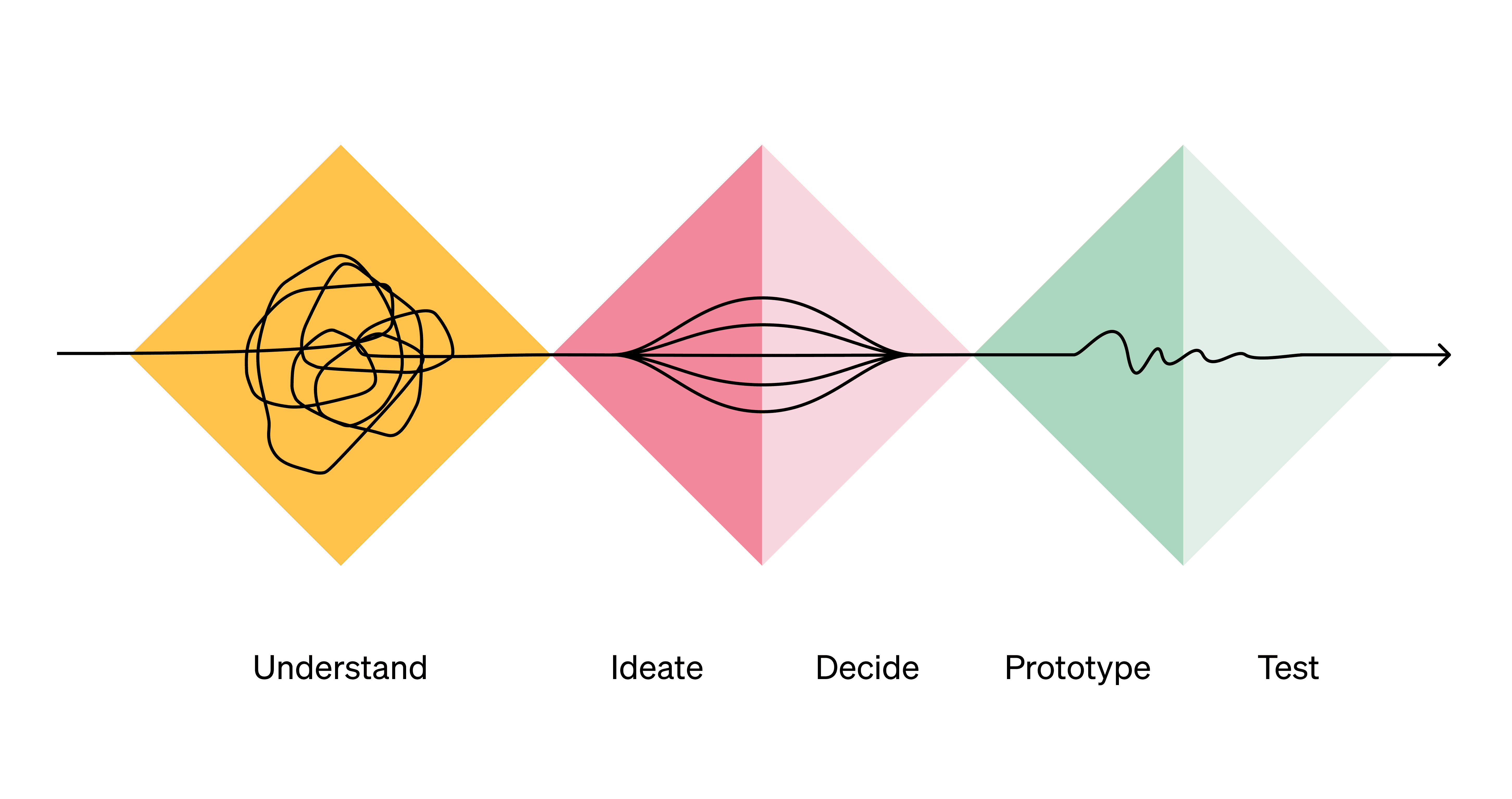
Understand
Day 1
We bring the right people into the room and agree on exactly what we are solving. We map the challenge end to end, surface the assumptions most likely to sink the project, and choose one specific target to build toward by the end of the week. Not the whole problem. The right slice of it.
Understand
Day 1
We bring the right people into the room and agree on exactly what we are solving. We map the challenge end to end, surface the assumptions most likely to sink the project, and choose one specific target to build toward by the end of the week. Not the whole problem. The right slice of it.
Understand
Day 1
We bring the right people into the room and agree on exactly what we are solving. We map the challenge end to end, surface the assumptions most likely to sink the project, and choose one specific target to build toward by the end of the week. Not the whole problem. The right slice of it.
Ideate
Day 2
Each team member independently generates competing solutions. Individual thinking before group discussion produces a wider range of ideas and avoids the pull toward consensus too early. Every concept gets captured. Nothing is filtered yet.
Ideate
Day 2
Each team member independently generates competing solutions. Individual thinking before group discussion produces a wider range of ideas and avoids the pull toward consensus too early. Every concept gets captured. Nothing is filtered yet.
Ideate
Day 2
Each team member independently generates competing solutions. Individual thinking before group discussion produces a wider range of ideas and avoids the pull toward consensus too early. Every concept gets captured. Nothing is filtered yet.
Decide
Day 3
We review every sketch through a structured process and converge on a single direction. A detailed storyboard maps out the prototype step by step. Decisions are made deliberately and grounded in the sprint's target, so there is no ambiguity about what we are building or why.
Decide
Day 3
We review every sketch through a structured process and converge on a single direction. A detailed storyboard maps out the prototype step by step. Decisions are made deliberately and grounded in the sprint's target, so there is no ambiguity about what we are building or why.
Decide
Day 3
We review every sketch through a structured process and converge on a single direction. A detailed storyboard maps out the prototype step by step. Decisions are made deliberately and grounded in the sprint's target, so there is no ambiguity about what we are building or why.
Prototype
Day 4
In a single day, we build something realistic enough that a real user can interact with it honestly. It will not be production-ready. That is the point. The goal is something testable, not something shippable.
Prototype
Day 4
In a single day, we build something realistic enough that a real user can interact with it honestly. It will not be production-ready. That is the point. The goal is something testable, not something shippable.
Prototype
Day 4
In a single day, we build something realistic enough that a real user can interact with it honestly. It will not be production-ready. That is the point. The goal is something testable, not something shippable.
Test
Day 5
We put the prototype in front of five real users and watch. Patterns emerge fast. By end of day, we know what works, what does not, and what the right next step is. That level of certainty is hard to get any other way.
Test
Day 5
We put the prototype in front of five real users and watch. Patterns emerge fast. By end of day, we know what works, what does not, and what the right next step is. That level of certainty is hard to get any other way.
Test
Day 5
We put the prototype in front of five real users and watch. Patterns emerge fast. By end of day, we know what works, what does not, and what the right next step is. That level of certainty is hard to get any other way.
When a Sprint is the right fit
A sprint works best when:
You have a new idea and need to know if it is worth building before committing to development
You are facing a specific design or UX problem in an existing product and need a tested solution fast
You want to validate a direction before moving into a full build
You need something concrete to bring back to your leadership team, board, or investors
You are improving or refining a product that is not working the way it should
If the shape of the problem itself is still unclear, Product Discovery is likely the better starting point. A sprint works best when you know roughly what you want to solve. Discovery is for when you are still figuring out what the right thing to build is.
If you already know what to build and are ready to move into development, our Product Delivery team picks up where the sprint leaves off.
When a Sprint is the right fit
A sprint works best when:
You have a new idea and need to know if it is worth building before committing to development
You are facing a specific design or UX problem in an existing product and need a tested solution fast
You want to validate a direction before moving into a full build
You need something concrete to bring back to your leadership team, board, or investors
You are improving or refining a product that is not working the way it should
If the shape of the problem itself is still unclear, Product Discovery is likely the better starting point. A sprint works best when you know roughly what you want to solve. Discovery is for when you are still figuring out what the right thing to build is.
If you already know what to build and are ready to move into development, our Product Delivery team picks up where the sprint leaves off.